


Hole Eater 3D: Relaxing Puzzle
Zenergy Game
I spent time with Hole Eater 3D: Relaxing Puzzle as a light, casual game rather than something demanding constant concentration. Its central idea is easy to understand: guide a black hole around a 3D play area, swallow suitable objects, and keep progressing through compact puzzle-like challenges. That simplicity is the main attraction. I could open it for a short break, understand the immediate goal quickly, and start playing without learning a complicated control system.
Developed by Zenergy Game, it is free to install and aimed at Everyone. The game has reached more than one hundred thousand installs and holds a 4.7 average from around five and a half thousand ratings, which fits my impression of a title designed for broad, low-pressure play. It is currently listed as version 3.5.1 and runs on Android 6.0 or later. Optional purchases range from $0.99 to $99.99 per item, so I would treat the free download as the starting point and check the purchase prompts carefully rather than assuming every part of the experience is included without interruption.
How the basic play loop feels in everyday use
The first useful habit is to separate movement from planning. It is tempting to sweep the hole across the screen immediately, especially when several objects are visible. I found that a slower opening pass works better: look at the arrangement, identify the easiest objects to consume, and then move along a route that leaves room for the hole to grow or reposition. That small pause makes the game feel more like a spatial puzzle and less like random swiping.
The black-hole theme gives the game a satisfying sense of progress. Objects disappear as they are swallowed, and the changing space makes each successful move immediately visible. I particularly liked the way a cleared patch can act as a visual marker. Instead of trying to remember every object, I could use the empty area to judge where I had already worked and where a safer route remained.
A realistic use case is a short wait at a bus stop or a few minutes before an appointment. I would not choose it for a long story session, because the appeal comes from the immediate action rather than narrative development. It works best when I want something understandable within seconds, with enough movement and decision-making to keep the break from feeling completely passive.
Related News






The controls are approachable, but that does not mean every move is equally effective. Quick gestures can send the hole past a useful object or into an awkward position. My most reliable routine was to make broad movements only when the area was open, then switch to shorter corrections near clusters. This is a simple technique, but it reduces wasted motion and helps preserve a clean route through the level.
Build a repeatable opening routine
Experienced play starts before the first object disappears. I recommend scanning the whole visible area and choosing a starting direction based on space, not just on the nearest target. A nearby object may be easy to reach but leave the hole facing a crowded edge. A slightly farther object can create a better line for the next few moves.
After the first successful swallow, I reassess rather than continuing on autopilot. The hole’s position and the remaining layout have changed, so the original route may no longer be ideal. This habit is especially helpful when several objects are grouped together. I clear one side, pause briefly, and then choose the next group from the new position.
Gallery
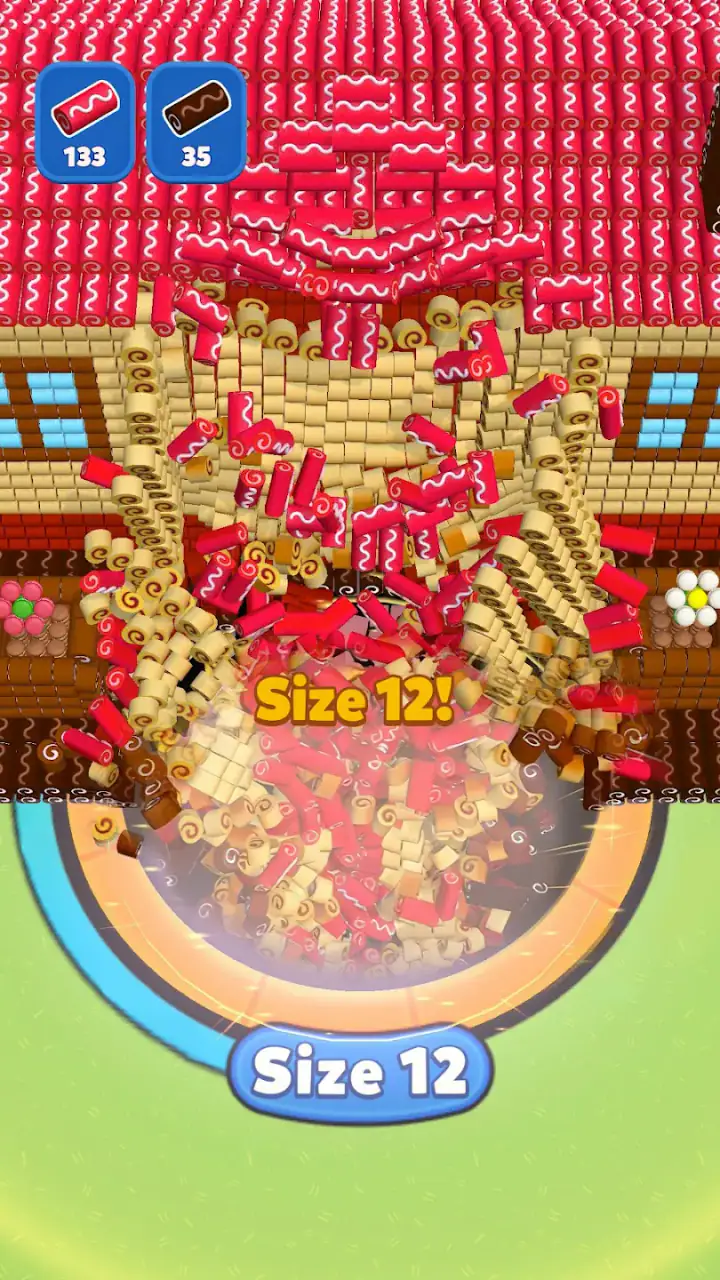
Another practical tip is to avoid circling aimlessly around a cluster. Repeatedly approaching the same objects from different angles feels active but often produces little progress. I get better results by selecting one edge of the group, entering once, and then using the cleared space to exit. That approach keeps the board easier to read and makes mistakes less frustrating.
Settings and purchase decisions deserve a quick check
Before settling into longer sessions, I would look through the available in-game settings and prompts rather than tapping through every screen automatically. The most important practical question is how the game presents optional purchases and whether any visual or control options make play more comfortable on your device. I would also check the sound behavior in a public place, since a relaxing game can become irritating if audio starts unexpectedly during a quiet moment.
Because the game is free, the purchase screen matters as much as the movement itself for some players. Optional items are priced from $0.99 up to $99.99, a wide range that makes it sensible to keep accidental spending in mind. I prefer to play the free portion first, understand what interruptions or conveniences appear during normal use, and only then decide whether anything offered is genuinely useful to me.
I would not recommend handing the phone to a young child without checking the device’s purchase protections first. The content rating is Everyone, which makes the theme broadly accessible, but an age-friendly game can still display purchase options that deserve adult attention. That is a device-management issue rather than a criticism of the puzzle design, but it is worth considering in a family setting.
The minimum operating-system requirement is Android 6.0, so the game is not restricted to recent phones. On an older device, I would still close unnecessary apps before playing if the screen feels slow to respond. Precision matters more than raw speed here: a small delay can turn a careful approach into an accidental overshoot. I would also avoid judging the game after only one rushed session, because the control feel becomes easier to read once the opening routine is familiar.
Use movement patterns instead of chasing every object
The fastest pattern is not always the most direct one. When objects appear in a line, I try to enter from the end that leaves the most open space behind me. This creates a natural sweep and prevents the hole from repeatedly crossing the same territory. It is a modest efficiency gain, but over several levels it makes the experience feel calmer and more deliberate.
For dense groups, I use a shallow arc rather than a series of sharp turns. The arc keeps momentum predictable and lets me correct gradually. Sharp changes are useful when an object is isolated, but they become risky when the screen is crowded. This is one of the clearest differences between simply moving the hole and actually learning its play space.
I also found it helpful to treat the edges as boundaries to manage, not destinations to visit automatically. Moving toward an edge can be correct when it clears a difficult object, but hugging the boundary for too long reduces the room available for correction. I aim to leave myself an exit direction before committing to a tight corner.
When I make a poor approach, I do not immediately repeat the same gesture. I first identify what caused the problem: was the target too close to the edge, did I enter the group at the wrong angle, or did I move too quickly? That short diagnosis turns a failed attempt into a useful adjustment. It also keeps the game from becoming a cycle of increasingly frantic swipes.
Where the relaxing design reaches its limits
The same simplicity that makes this game accessible can limit its appeal for players who want deep progression, a strong competitive layer, or a story to follow. I would choose a more complex puzzle game if I wanted elaborate logic, persistent character development, or a long-term strategic system. Here, the pleasure comes from positioning, clearing space, and repeating a compact interaction.
There is also a trade-off between relaxation and challenge. If you prefer games that constantly introduce new rules, the black-hole mechanic may begin to feel familiar. The store summary emphasizes swallowing and growing through an io-style puzzle experience, and that accurately describes the focus: the game is about the immediate physical satisfaction of consuming objects, not about building a large world around that mechanic.
Players who dislike touch controls may need patience at first. The game’s concept is easy, but accurate movement still depends on how confidently you guide the hole. I would skip it if you want buttons, a controller-first design, or strict turn-based precision. It is better suited to someone comfortable with direct screen movement and willing to use small corrections.
The free-to-play structure is another point to weigh. Since optional purchases can reach a high price, I would not recommend it to someone looking for a completely purchase-free experience without checking how the game behaves during ordinary play. For me, the right approach is to regard purchases as optional conveniences, not as part of the reason to install it. If the prompts become more noticeable than the puzzle, the game loses much of its relaxing quality.
Who will get the most from it
I think this is a good match for casual players who enjoy short sessions, simple objectives, and a visual sense of clearing a space. It is also suitable for someone introducing a younger player to a nonviolent puzzle game, provided purchase controls are secured on the device. The Everyone rating supports that broad audience, while the straightforward black-hole mechanic removes much of the barrier that more complicated games create.
It is less suitable for people who need a substantial reason to return every day. I would also point elsewhere if your priority is multiplayer competition, rich customization, or a carefully layered campaign. The game’s strength is its immediate loop, so expectations matter. Approached as a pocket-sized distraction, it feels focused. Approached as a deep puzzle system, it may feel lightweight.
Compared with the usual alternatives in casual mobile gaming, it sits between a simple arcade toy and a spatial puzzle. It has more decision-making than a purely reflex-based tap game, but less long-term planning than a traditional logic title. That middle position is useful when I want to think just enough to stay engaged without committing to a difficult problem or a lengthy session.
My verdict after settling into the rhythm
My strongest recommendation is to play deliberately: scan first, choose a route with an exit, use broad movements only in open areas, and make small corrections around clusters. Those habits reveal the game’s better side. What initially looks like mindless swallowing becomes a modest exercise in spatial awareness, especially when I stop chasing the nearest object and start planning the next two moves.
I would install it for quick, low-pressure entertainment and keep my expectations focused on that role. The free entry point, Everyone rating, broad device compatibility, and strong average rating make it easy to try, while the optional purchase range means I would pay attention to prompts and spending controls. The current version, 3.5.1, is the one to look for when checking compatibility on an Android device.
In the end, Hole Eater 3D: Relaxing Puzzle succeeds because it does not make its central idea difficult to understand. Its best moments come from turning a few careful movements into a clean sweep, then using the newly opened space to plan the next approach. I would recommend it to a friend who wants a gentle casual game for spare minutes, but not to someone searching for a deep campaign or a completely distraction-free alternative to premium puzzle games.
FAQs for Hole Eater 3D: Relaxing Puzzle
What is Hole Eater 3D: Relaxing Puzzle?
Hole Eater 3D: Relaxing Puzzle is a casual arcade game built around a simple but satisfying idea: control a moving hole and swallow objects from the environment. As the hole grows, it can consume larger items and clear more of each level. The gameplay is easy to understand, making it suitable for short sessions when you want something relaxing rather than a demanding strategy or action game.
How do you play Hole Eater 3D: Relaxing Puzzle?
The main objective is to guide the hole around each stage and collect the available objects before time runs out or the level’s conditions are no longer met. Smaller objects are generally eaten first, allowing the hole to expand and reach bigger targets. Controls are designed to be straightforward, usually relying on touch or swipe movement, so new players can begin without a lengthy tutorial.
Is Hole Eater 3D: Relaxing Puzzle suitable for children?
The game is generally appropriate for children because it uses colorful 3D visuals, simple controls, and non-violent gameplay. There are no complicated rules to memorize, and the core interaction is based on collecting objects and solving light environmental challenges. However, parents should still review the app’s advertising, in-app purchase options, and device settings, since these can vary depending on the version and platform.
Does Hole Eater 3D: Relaxing Puzzle require an internet connection?
The basic gameplay appears suited to offline play, which makes it convenient for quick entertainment while traveling or when a stable connection is unavailable. Nevertheless, some features may depend on internet access, including advertisements, promotional rewards, analytics, updates, or purchases. For the most reliable experience, install the latest official version and check its store listing for the developer’s current connectivity requirements.
Is Hole Eater 3D: Relaxing Puzzle free to download?
Hole Eater 3D: Relaxing Puzzle can generally be downloaded at no initial cost, allowing players to try its core mechanics before spending anything. Like many free mobile games, it may include advertising and optional in-app purchases, such as removing ads or obtaining gameplay-related bonuses. Before downloading, check the Google Play or App Store listing for the current pricing, permissions, and purchase information.
Pros
- Simple controls make it easy to start playing immediately.
- Short levels fit well into quick gaming sessions.
- Colorful 3D visuals give the puzzles a pleasant look.
- Satisfying hole mechanics make collecting objects feel rewarding.
- Gradual challenges help introduce new gameplay elements naturally.
Cons
- Gameplay can become repetitive after extended play.
- Some levels offer limited challenge for experienced puzzle fans.
- Ads may interrupt the experience between levels.
- The game may require internet access for certain features.
- Progression can feel slow without optional purchases.


